In September 2024, Hurricane Helene tore through western North Carolina and delivered an unscheduled stress test to the entire global semiconductor and solar supply chain. Roads washed out. Power went down for weeks. The quartz processing facilities in and around Spruce Pine — a small mountain town that happens to be the single most important source of ultra-high-purity quartz on the planet — went dark.
Within days, spot prices for high-purity quartz spiked 20–40%. Contract customers scrambled to assess their inventory positions. Crucible manufacturers in China and Japan started making phone calls they had been putting off for years. And procurement managers at some of the world's largest technology companies confronted a question that should have been asked a long time ago: why is so much of the modern economy dependent on a single valley in Appalachia?
If you are reading this and your quartz supply chain still has a single point of failure, this is your wake-up call. The window to diversify is open right now, but it will not stay open forever.
The Spruce Pine Problem: How One Town Holds the World Hostage
To understand why diversification is urgent, you first need to understand how we ended up in this situation. Spruce Pine sits on top of geological formations that are genuinely remarkable. The pegmatite deposits in the area yield quartz with natural purities that approach 4N to 5N — a geological rarity that has no true equivalent at the same scale anywhere else on Earth.
Two companies control the Spruce Pine supply: Sibelco (which acquired Unimin in 2018) and The Quartz Corp, a joint venture between Norwegian interests and Imerys. Between them, these two operations supply an estimated 90% of the world's 5N-grade (99.999%) high-purity quartz. Read that number again: ninety percent, from one geographic location, controlled by two companies.
The Concentration Risk in Numbers
Two companies, one mountain valley, ~90% of global 5N HPQ supply. Hurricane Helene caused 20–40% price spikes and weeks of production disruption. This is not a theoretical risk — it already happened.
This level of supply concentration is unusual even by the standards of critical minerals. Rare earth elements, despite all the hand-wringing about Chinese dominance, have diversified significantly over the past five years with projects in Australia, Canada, and elsewhere reaching commercial production. Cobalt supply has shifted as Indonesian production scaled up. But ultra-high-purity quartz? The diversification that should have happened a decade ago barely started until catastrophe forced the issue.
What Hurricane Helene Actually Disrupted
Let us be precise about the damage, because the details matter. When Helene hit in late September 2024, the immediate impact was infrastructure, not mining. The quartz deposits themselves were fine — you cannot destroy a geological formation with wind and rain. But the roads that truck raw material to the processing plants, the power grid that runs the crushing and purification circuits, the rail connections that move finished product to ports — all of that was severely damaged.
Sibelco's operations were offline for weeks. The Quartz Corp faced similar disruptions. For buyers with comfortable inventory buffers, the impact was manageable. For those running lean — which, in the era of just-in-time everything, describes most of them — it was an immediate crisis.
The price spikes told the story. High-purity quartz sand that had been trading at relatively stable levels saw spot prices jump 20–40% almost overnight. Some buyers reported being unable to secure spot tonnage at any price for the first few weeks. Crucible manufacturers in East Asia, who consume the majority of this material for solar silicon production, saw their feedstock costs spike at precisely the moment they could least afford it.
Production resumed, prices normalized somewhat, and the crisis passed. But the lesson should have been permanent: natural disasters are not the only threat to a geographically concentrated supply chain. Regulatory changes, labor disputes, environmental permitting delays, infrastructure failures, or even a simple equipment malfunction at the wrong facility could trigger a similar disruption.
The Geopolitical Layer: Russia, China, and Export Controls
Geography is only one dimension of supply chain risk. Geopolitics is the other, and it has been reshaping the high-purity quartz market since 2022.
Russian Quartz, based in Kyshtym in the Urals, had been building a credible position as an alternative 5N supplier before Russia's invasion of Ukraine upended everything. Western sanctions did not initially target quartz specifically, but the broader financial sanctions, shipping restrictions, and corporate self-sanctioning made doing business with Russian suppliers extremely difficult for Western buyers. Insurance became problematic. Banking channels closed. Logistics routes through European ports were no longer viable.
The result? One of the few genuine alternatives to Spruce Pine for ultra-high-purity quartz effectively disappeared from Western supply chains. Chinese buyers stepped in to absorb some of that Russian volume, but for anyone in the US, Europe, Japan, or South Korea, Russian quartz became a non-option essentially overnight.
Then there is China itself. Chinese companies have invested heavily in quartz processing capacity over the past decade, and China now dominates the midstream — the purification and processing steps that turn raw quartz into crucible-grade sand. Companies like Pacific Quartz (part of Fengyang in Anhui province), Jiangsu Pacific Quartz, and others have built significant processing capabilities.
The China Paradox
China processes more high-purity quartz than any other country, yet many Western and Japanese semiconductor manufacturers will not qualify Chinese-processed material due to quality perception issues and geopolitical risk. This creates a bifurcated market with very different supply dynamics in East and West.
But Chinese-processed HPQ faces a credibility problem in certain markets. Japanese semiconductor equipment makers and leading Western chip manufacturers often specify "non-China origin" for critical quartz components. Quality concerns are part of the issue — consistency and traceability standards vary widely across Chinese producers. But geopolitical risk is equally important. US-China tensions, the possibility of export controls in either direction, and the broader decoupling trend all make Chinese supply a strategic liability for some buyers, regardless of the technical quality.
The net effect of all this? The pool of acceptable HPQ suppliers for Western and allied buyers has actually shrunk over the past three years, even as demand has surged. That is a problem that only diversification can solve.
The Qualification Bottleneck: Why Starting Now Matters
Here is the detail that separates people who understand this industry from those who do not: qualifying a new quartz supplier is not like switching paper clip vendors. For high-purity applications — particularly crucibles for semiconductor and solar silicon production — the qualification cycle runs 6 to 18 months. Sometimes longer.
The process typically looks like this. Initial samples are submitted for full elemental analysis. If the chemistry passes, trial quantities are processed into crucibles or components for testing. Those components are evaluated in actual production conditions — meaning a crucible manufacturer has to run silicon pulls with the new material and verify that the resulting silicon meets all quality parameters. If there are problems at any stage, the cycle resets.
This is why the time to start qualifying alternative suppliers is before you need them. Once a supply disruption hits, you are 6 to 18 months away from having a qualified alternative even if you start that day. The buyers who moved early in 2024 and 2025 to begin qualifying new sources are now reaping the benefits of that foresight. Those who waited are still exposed.
We talk to procurement teams regularly who acknowledge the risk but have not acted because "we are locked into long-term contracts with our current supplier." Long-term contracts are worthless when force majeure kicks in. Your contract guarantees price and volume — it does not guarantee that a hurricane will not destroy the road to the mine.
The China+1 Strategy Comes to Quartz
The manufacturing world has spent the past five years executing "China+1" strategies across dozens of commodities and components. The idea is simple: maintain your Chinese supply relationships, but qualify at least one non-China alternative for every critical input. It started in electronics assembly, spread to battery materials, hit rare earths, and now it has reached high-purity quartz.
For quartz, the "+1" question is particularly acute because the alternatives are not just about avoiding China — they are about reducing concentration risk across the entire supply base. A buyer whose primary source is Spruce Pine and whose backup is a Chinese processor has diversified geographically but not strategically. Both sources face significant risk factors, just different ones.
True resilience means having qualified suppliers in at least two, preferably three, distinct geographies with independent logistics chains. That is the standard the automotive industry adopted years ago for critical components. The semiconductor and solar industries are now catching up.
Emerging Alternative Sources: The New Geography of HPQ
So where do you go if you want to diversify away from Spruce Pine and reduce China exposure? The geological reality is that high-purity quartz deposits exist in more places than most people realize. The challenge has always been economic — developing a deposit, building processing infrastructure, and achieving the consistency required for advanced applications takes years of investment and expertise.
Several regions are emerging as credible alternatives:
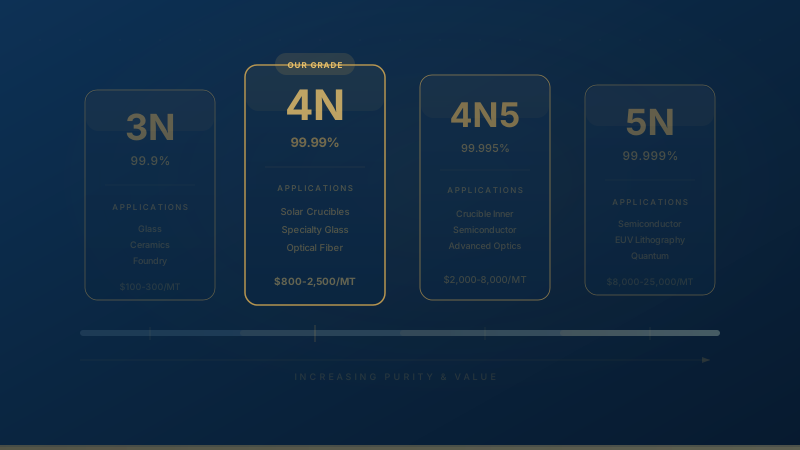
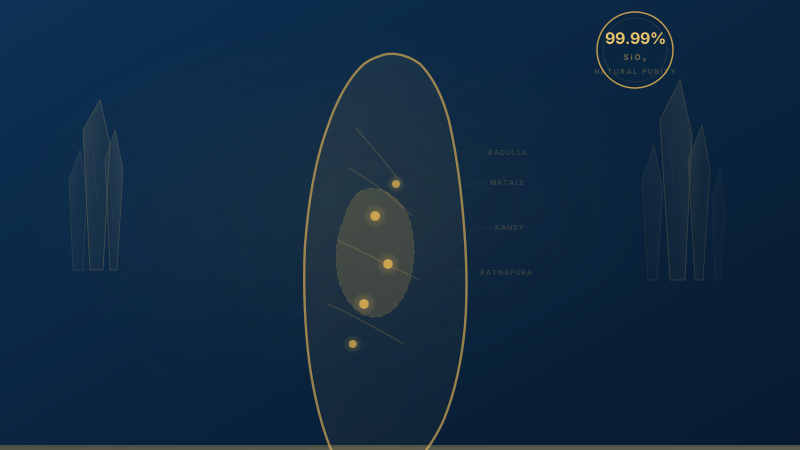
Sri Lanka stands out for several reasons. The island's vein quartz deposits, concentrated in the central and southern highlands, yield raw material with natural purities that frequently reach 4N grade (99.99%) before any chemical processing. That is a significant geological advantage — it means less acid leaching, lower processing costs, and fewer environmental challenges compared to deposits that start at 3N and need to be pushed up through intensive chemical treatment.
Sri Lanka's Strategic Position
Natural 4N purity vein quartz. Strategic Indian Ocean location between Middle Eastern, South Asian, and East Asian markets. Cost-effective processing and labor. No geopolitical trade restrictions with any major market. Active government support for mineral value-addition exports.
Sri Lanka's geographic position is another advantage that does not get enough attention. Colombo Port sits on one of the world's busiest shipping lanes, with direct connections to major markets in Japan, South Korea, China, India, and Europe. Shipping costs and transit times to East Asian crucible manufacturers are competitive with or better than shipping from North Carolina.
India has extensive quartz resources, particularly in Rajasthan, Andhra Pradesh, and Tamil Nadu. Several Indian companies have been investing in HPQ processing capabilities, and the Indian government's emphasis on semiconductor self-sufficiency through the India Semiconductor Mission is creating domestic demand that will pull investment into the supply chain. The challenge in India is consistency — the deposit geology is variable, and processing standards need to continue improving to meet the most demanding specifications.
Australia has multiple advanced-stage HPQ projects in Queensland and Western Australia. Companies like Covalent Lithium (as a byproduct) and dedicated quartz developers are moving toward production. Australia brings political stability, strong mining governance, and existing trade relationships with key Asian markets. Costs are higher than South Asian alternatives, but for buyers prioritizing supply security and regulatory transparency, Australia is an increasingly attractive option.
Canada is another jurisdiction with promising HPQ deposits, particularly in Quebec. The Canadian Critical Minerals Strategy explicitly includes high-purity silica, and several projects are in development. The proximity to the US market is a clear advantage, though most Canadian projects are still years from commercial production at scale.
Japan and South Korea: Building Strategic Reserves
The response to supply chain vulnerability has not been limited to sourcing diversification. Japan and South Korea, both heavily dependent on imported HPQ for their semiconductor industries, have begun building strategic mineral reserves that include high-purity quartz.
Japan's JOGMEC (Japan Organization for Metals and Energy Security) has expanded its scope to include critical minerals for the semiconductor supply chain. South Korea's Ministry of Trade has similarly flagged HPQ as a strategic material requiring supply security measures. Both countries are actively funding exploration partnerships in allied nations and stockpiling processed material.
For suppliers in emerging HPQ jurisdictions, this government-backed buying interest represents a significant opportunity. Japanese and Korean buyers bring long-term contract commitments, technical collaboration, and pricing stability. For buyers, the involvement of national strategic reserve programs signals that supply risk is real enough for governments to act on it — which should tell private sector procurement teams something about the urgency of their own diversification efforts.
How to Build a Resilient Quartz Supply Chain
Diversification is not just about having multiple names in your supplier database. It requires deliberate planning and investment. Here is a practical framework based on what we see the most sophisticated buyers doing:
Map your current exposure honestly. What percentage of your HPQ comes from a single source? A single geography? A single logistics corridor? If the answer to any of these is above 70%, you have a vulnerability that needs addressing. And be honest about your "backup" suppliers — if they have never actually delivered production volumes, they are not backup suppliers, they are contacts.
Start the qualification process with at least two new sources immediately. Not one — two. Because qualification is not guaranteed to succeed. Geology surprises you, processing consistency falls short, logistics prove more expensive than projected. Having two candidates in the pipeline means you are more likely to end up with at least one viable alternative.
Stagger your qualifications across geographies. If your primary source is North American, qualify one South Asian and one Australian alternative. If you are already buying from China, add a non-Asian source. The goal is not just supplier diversification — it is geographic and logistic diversification.
Commit meaningful volume to your secondary suppliers. A supplier who receives 5% of your volume will never invest in the consistency and capacity improvements needed to serve you reliably in a crisis. Aim for at least 20–30% of your volume going to your secondary source. This gives them the revenue to invest in quality and gives you the confidence that comes from regular production runs on their material.
Build inventory buffers for the highest-grade material. For 5N-grade quartz, carrying 3–6 months of safety stock is not excessive given the supply concentration and the consequences of a stockout. The carrying cost of quartz inventory is low relative to the business impact of shutting down a $10 billion semiconductor fab because you ran out of crucible sand.
Invest in supplier development. The most forward-thinking buyers are not just purchasing from emerging suppliers — they are actively helping them improve. Sharing specifications in detail, providing feedback on test results, connecting suppliers with third-party testing labs, even co-investing in processing equipment. This is not charity — it is enlightened self-interest. A stronger, more capable supplier base benefits everyone in the chain.
The Cost of Inaction
Let us put some numbers on the risk. A major solar cell manufacturer consuming 500 MT of 4N5 quartz annually at $5,000/MT faces a $2.5 million annual materials bill. A 30% price spike during a supply disruption adds $750,000 in unplanned cost. But the real damage is not the price increase — it is the production downtime. If you cannot get material at all for two months, and your facility produces $50 million worth of solar cells monthly, the opportunity cost is $100 million. Against that exposure, the cost of qualifying and maintaining a secondary supplier looks trivial.
For semiconductor manufacturers, the math is even more stark. A modern chip fab's output is measured in billions of dollars annually. The quartz crucibles and components are a tiny fraction of total input costs, but they are on the critical path. No crucibles, no wafers. No wafers, no chips. No chips, and very expensive equipment sits idle while very expensive engineers wait.
The Bottom Line
The cost of diversifying your HPQ supply chain is measured in hundreds of thousands of dollars. The cost of not diversifying, when the next disruption hits, is measured in tens or hundreds of millions. The math is not complicated.
The Window Is Open. It Will Not Stay Open.
Here is what concerns us most about the current moment. The Helene disruption created a surge of interest in supply chain diversification. Inquiries to alternative suppliers spiked. Conferences were held. Reports were published. But memory fades. As Spruce Pine operations normalized and prices pulled back, we watched some of that urgency dissipate.
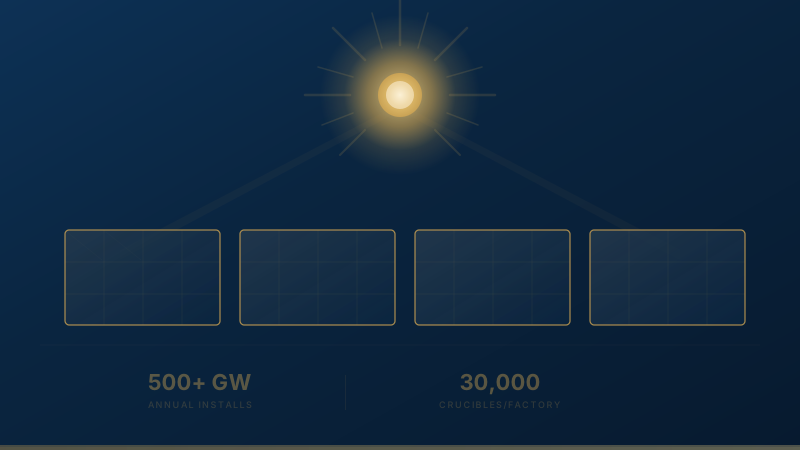
Meanwhile, the structural factors driving supply risk have not changed. Solar manufacturing capacity continues to expand at a staggering pace, pulling more and more HPQ demand onto a supply base that is not growing at the same rate. Semiconductor fabs under construction in the US, Europe, Japan, and India will add further demand when they come online. Geopolitical tensions show no sign of easing.
The emerging alternative suppliers we discussed — in Sri Lanka, India, Australia, Canada — are scaling up, but they cannot absorb a sudden demand surge overnight. The ones who are advancing fastest are doing so because they already have committed buyers running qualification programs. The best deposits, the best processing capacity, and the best offtake terms are being locked up now by the buyers who moved first.
If you are a procurement manager responsible for HPQ sourcing, there are really only two questions that matter. First: what is your exposure if your primary supplier goes down for three months? And second: what are you doing about it this quarter? Not next year. Not after the next disruption. This quarter.
The buyers who answer those questions honestly and act on the answers will be the ones still running when the next hurricane, the next sanctions package, or the next supply shock arrives. And in this market, the next one is not a question of if — it is a question of when.