If you have been buying quartz for any length of time, you have almost certainly run into the "N" grading system. A supplier tells you their material is "4N grade" and quotes a price. Another supplier offers "4N5" at triple the cost. A third claims "5N capable" but the Certificate of Analysis tells a different story.
This guide is for procurement managers, quality engineers, and sourcing teams who need to cut through the noise. We will walk through exactly what each purity grade means, what it costs, what impurities matter for your application, and how to avoid the most common traps buyers fall into when sourcing high-purity quartz.
What the "N" System Actually Means
The "N" in quartz grading stands for "nines" — specifically, the number of nines in the SiO2 purity percentage. It is a shorthand borrowed from the semiconductor and metals refining industries, where purity is everything. A material graded "3N" contains 99.9% SiO2. That is three nines. "4N" means 99.99% — four nines. And so on.
The important thing to understand is that each additional nine represents a tenfold reduction in total impurities. Going from 3N to 4N means cutting your total impurity load from 1,000 parts per million down to 100 ppm. That might not sound dramatic until you realize it typically requires entirely different processing technology, stricter source material selection, and significantly more energy and chemical input. Which is exactly why the price jumps are not linear — they are exponential.
You will also encounter "half grades" like 4N5, which represents 99.995% purity — four and a half nines. This grade has become critically important in the solar industry over the past decade, and we will get to why shortly.
3N Grade (99.9% SiO2): The Industrial Workhorse
At 99.9% purity, you are looking at quartz suitable for glass manufacturing, ceramics, foundry sand, and general industrial applications. Total impurities sit at around 1,000 ppm, which is perfectly acceptable when your end product does not need optical clarity or extreme thermal performance.
Market Pricing: 3N Grade
$100–300 per metric ton, depending on particle size, geography, and volume. This is a commodity market with thin margins.
Most 3N material comes from abundant vein quartz or quartzite deposits. Processing is relatively straightforward — crushing, washing, magnetic separation, and basic flotation will get you there from decent feedstock. Competition is fierce, sourcing options are plentiful, and unless you are buying thousands of tons monthly, your negotiating leverage is limited.
The key quality parameters at this grade are particle size distribution and consistency of the iron content. Even at 3N, a buyer making clear container glass will reject material with Fe2O3 above 100 ppm. A foundry buying the same grade for casting sand could not care less about iron levels.
4N Grade (99.99% SiO2): Where Things Get Serious
Cross the threshold into 4N territory and the market changes completely. At 99.99% purity, total impurities drop to around 100 ppm. This grade serves the outer layers of solar crucibles, specialty optical glass, high-performance lighting, and precision optics applications.
Market Pricing: 4N Grade
$800–2,500 per metric ton. The spread is wide because specifications within 4N vary enormously by application.
The processing chain for 4N material is considerably more involved. You are typically looking at hot chlorination, acid leaching (often multi-stage with HCl and HF), advanced flotation, and careful thermal treatment. Not every deposit can produce 4N material regardless of how much processing you throw at it — the feedstock geology has to be right from the start.
This is also where the supplier landscape starts to narrow. Dozens of producers worldwide can deliver consistent 3N material. Genuine 4N producers? Maybe a few dozen globally, and half of those are in China. The qualification process gets longer, the technical discussions get deeper, and relationships matter more than spot pricing.
4N5 Grade (99.995% SiO2): The Solar Sweet Spot
If you are in the photovoltaic supply chain, 4N5 is probably the grade that keeps you up at night. This is the specification for the inner layer of quartz crucibles used in the Czochralski (CZ) process for pulling monocrystalline silicon ingots. Every solar cell on every rooftop panel likely started its life inside a 4N5-grade crucible.
Market Pricing: 4N5 Grade
$2,000–8,000 per metric ton. Pricing has been volatile since 2023, driven by surging solar demand and supply chain disruptions.
The particle size specification for crucible-grade sand is typically 100–300 mesh (roughly 50–150 microns). This is critical. Too coarse and the crucible wall will have porosity issues. Too fine and the material will not sinter properly. Crucible manufacturers are exacting about particle size distribution, and they will reject entire shipments over a PSD that drifts out of spec.
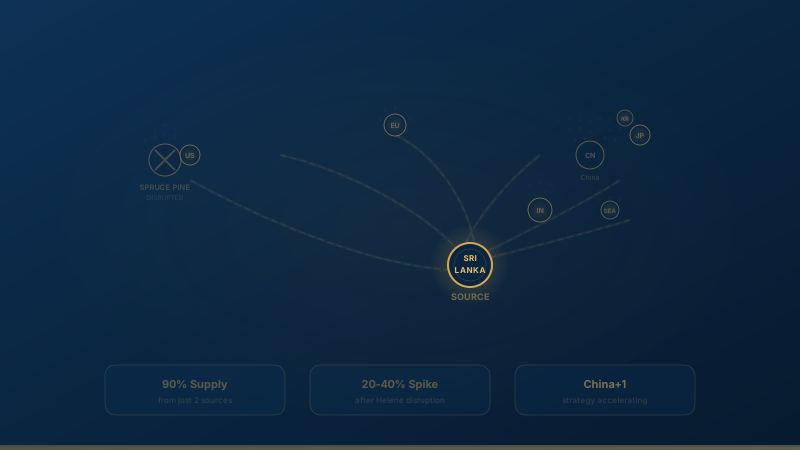
Global supply of genuine 4N5 material is surprisingly tight. The Spruce Pine deposits in North Carolina have historically been the gold standard, but a handful of deposits in Norway, India, Sri Lanka, and Australia are being developed or expanded to meet the explosion in solar manufacturing capacity.
5N Grade (99.999% SiO2): The Pinnacle
Five-nines purity is where quartz becomes a truly strategic material. At 99.999% SiO2, total impurities are held below 10 ppm. This grade is required for semiconductor-grade crucibles, advanced optical components, and specialty applications in aerospace and defense.
Market Pricing: 5N Grade
$8,000–25,000+ per metric ton. At the upper end, pricing is often negotiated case-by-case and rarely published openly.
The number of operations worldwide that can consistently produce verified 5N quartz sand can be counted on two hands. Sibelco's Spruce Pine operations and The Quartz Corp's Norwegian-sourced material (processed in Spruce Pine) dominate this ultra-premium segment. Russian Quartz had been a meaningful player before geopolitical events reshuffled the deck after 2022.
At this grade, the conversation shifts from bulk impurities to individual elemental limits that would make most analytical chemists nervous. We are talking about controlling boron and phosphorus to below 0.1 ppm, which requires extraordinarily clean processing environments and feedstock that is geologically rare.
Critical Impurities: What Buyers Actually Test For
Purity grades tell you the total impurity picture, but experienced buyers know the real story is in the individual elements. Different applications have different elemental sensitivities, and two samples at the same overall purity grade can perform very differently depending on which impurities are present.
Here are the elements that matter most, along with the limits that solar and semiconductor buyers typically specify:
| Element | Solar Crucible (4N5) | Semiconductor (5N) | Why It Matters |
|---|---|---|---|
| Aluminum (Al) | <15–20 ppm | <10 ppm | Affects crucible bubble formation and devitrification |
| Iron (Fe) | <2–5 ppm | <1 ppm | Metallic contamination, carrier lifetime killer in silicon |
| Titanium (Ti) | <1–2 ppm | <1 ppm | Contributes to devitrification, impacts optical clarity |
| Sodium/Potassium (Na/K) | <2–5 ppm | <1 ppm | Alkali metals accelerate cristobalite formation |
| Boron (B) | <0.5 ppm | <0.1 ppm | P-type dopant — even trace amounts alter silicon properties |
| Phosphorus (P) | <0.5 ppm | <0.1 ppm | N-type dopant — uncontrolled doping destroys device yields |
Aluminum is usually the single largest impurity in any quartz sample, and it is also the hardest to remove because it substitutes directly into the crystal lattice. Iron, by contrast, tends to sit on grain boundaries and surfaces, which is why acid leaching is so effective at reducing Fe levels. Understanding this distinction matters when you are evaluating whether a supplier can realistically hit the specs they are promising.
Boron and phosphorus deserve special attention. These elements act as dopants in silicon — boron creates p-type conductivity, phosphorus creates n-type. In semiconductor manufacturing, dopant levels are controlled with extreme precision. If your crucible is leaching even trace amounts of B or P into the silicon melt, you have a serious problem. This is why 5N specifications for these two elements are an order of magnitude tighter than for the metallic impurities.
Testing Methods: ICP-OES vs. ICP-MS
Two analytical techniques dominate quartz purity testing: Inductively Coupled Plasma Optical Emission Spectrometry (ICP-OES) and Inductively Coupled Plasma Mass Spectrometry (ICP-MS). Which one your supplier uses — and which one you should insist on — depends on the grade.
ICP-OES is the standard workhorse for 3N and 4N material. It offers reliable detection limits down to roughly 1–5 ppm for most elements, which is more than adequate when your total impurity budget is measured in hundreds of ppm. The cost per analysis is reasonable, turnaround is quick, and most commercial labs can handle it.
For 4N5 and 5N material, ICP-MS becomes necessary. It pushes detection limits down to the parts-per-billion range, which is essential when you need to verify that boron is below 0.1 ppm or that phosphorus is sitting at 50 ppb. If a supplier of supposed 5N material is only providing ICP-OES data, that is a red flag. They literally cannot prove the purity they are claiming with that instrument.
Third-Party Testing Is Non-Negotiable
For any purchase above 4N grade, insist on analysis from an accredited third-party laboratory. SGS, Bureau Veritas, and ALS Global are the most commonly used in the minerals sector. Supplier self-testing is fine for screening, but it should never be the basis for a purchase decision at premium grades.
What a Proper Certificate of Analysis Should Include
A COA is only as useful as the information it contains. We have seen buyers accept COAs that would not survive five minutes of scrutiny. At a minimum, your COA for high-purity quartz should include:
- •Full elemental analysis covering at minimum: Al, Fe, Ti, Ca, Mg, Na, K, Li, B, P, Cr, Mn, Cu, Ni, Zr
- •Analytical method specified (ICP-OES or ICP-MS) with detection limits stated
- •Sample identification traceable to a specific lot, shipment, or production batch
- •Particle size distribution (PSD) — D10, D50, D90 values at minimum
- •Moisture content
- •Laboratory name and accreditation (ISO 17025 preferred)
- •Date of analysis — a COA older than 6 months should trigger a re-test
If any of these items are missing, ask for them. If the supplier pushes back on providing third-party lab data, that tells you something about either their product or their business practices. Either way, proceed with caution.
How to Evaluate a Supplier's Quality Claims
Over the years, we have watched buyers get burned by suppliers who overstate their purity capabilities. Here is a practical framework for evaluating claims:
Ask for historical data, not just a single COA. Any supplier can cherry-pick their best batch result. What you need to see is consistency across multiple production runs. Request COAs from at least three to five recent shipments. If the aluminum content swings from 12 ppm to 35 ppm across those batches, the "4N5" claim starts to look shaky.
Understand the deposit geology. A supplier processing vein quartz from a pegmatite deposit in Sri Lanka starts with naturally lower impurities than one working a hydrothermal deposit in China. That geological advantage translates into more consistent output and lower processing costs. Ask about the source geology — a credible supplier will be happy to discuss it.
Visit the processing facility if volumes justify it. For purchases above $500,000 annually, a site visit is standard practice. You want to see the acid leaching setup, the water treatment system, the quality control lab, and the storage and packing areas. Contamination can happen at any point in the chain, and a walkthrough reveals more than any document.
Check for customer references in your target application. A supplier selling 4N5 quartz to crucible manufacturers has already been through the qualification gauntlet with demanding buyers. If their customer list is entirely glass and ceramics buyers, stepping up to crucible-grade supply is a different challenge.
Common Mistakes Buyers Make When Sourcing Quartz
After working in this industry for years, certain patterns keep repeating. Here are the mistakes we see most frequently:
Fixating on SiO2 percentage while ignoring specific elements. A sample at 99.996% SiO2 might look great on paper. But if the remaining 40 ppm is mostly aluminum (which is hard to remove further) versus mostly iron (which is relatively easy to address), the implications are completely different. Always look at the full elemental breakdown.
Accepting supplier self-testing at face value. We mentioned this earlier, but it bears repeating. A supplier's internal lab has an inherent conflict of interest. This does not mean they are dishonest — it means the system lacks the checks that protect both parties. Third-party verification exists for a reason.
Neglecting particle size distribution. Purity is only half the specification for crucible-grade sand. We have seen buyers negotiate fiercely on impurity limits and then barely glance at the PSD data. A crucible manufacturer will reject material that is the wrong particle size regardless of how pure it is. Typical specs call for 100–300 mesh, but the distribution within that range matters just as much as the endpoints.
Sourcing from a single supplier. The Hurricane Helene disruption at Spruce Pine taught the industry a painful lesson about single-source dependency. Even if your primary supplier is excellent, qualifying a backup source is basic supply chain hygiene. Yes, qualification takes 6–18 months. Start now.
Why Consistency Matters More Than Peak Purity
This might be the single most important point in this entire guide. Buyers chase peak purity numbers — they want to see that headline "99.998%" figure on the COA. But what actually determines whether your production line runs smoothly or grinds to a halt is consistency.
A supplier delivering 99.995% with a tight standard deviation of ±0.001% across every batch is worth more to your operation than one who occasionally hits 99.998% but swings down to 99.990% on other shipments. Your process engineers calibrate for a specific input quality. Every time that input changes, they are troubleshooting instead of producing.
The Consistency Principle
A consistent 4N5 supplier is more valuable than an inconsistent 5N supplier. Ask for batch-to-batch variation data before you ask for peak results. This single metric separates serious producers from those still figuring out their process.
Consistency comes from three things: a uniform deposit with well-characterized geology, a mature and stable processing workflow, and rigorous quality control with statistical process monitoring. When evaluating a new supplier, dig into all three. A newer operation running a recently commissioned plant on a deposit that has only been partially characterized is a higher-risk proposition, regardless of what their best COA shows.
The Bottom Line for Buyers
The quartz purity grading system is straightforward in concept but nuanced in practice. The "N" number gives you a starting point, but it is never the full picture. Smart procurement means understanding which impurities matter for your specific application, insisting on proper analytical methods, demanding consistency over peak results, and building relationships with suppliers who are transparent about both their capabilities and their limitations.
The market for high-purity quartz is only getting tighter as solar manufacturing scales and semiconductor fabs proliferate. The buyers who understand the technical details and build robust, diversified supply chains will have a meaningful advantage over those who are still buying on price and hope.