There's a material that the solar industry absolutely cannot function without, and it isn't silicon. Well, not exactly. Before you can grow a silicon ingot, before you can slice a wafer, before you can deposit a single photovoltaic layer, you need a crucible. And that crucible is made from high purity quartz sand.
If you've been tracking the solar boom purely through panel prices and installation numbers, you're missing half the story. The real bottleneck narrative in photovoltaic manufacturing over the past three years hasn't been about polysilicon shortages or silver paste costs. It's been about quartz. Specifically, the kind of quartz sand pure enough to survive the punishing thermal environment inside a Czochralski crystal puller.
And the numbers are staggering.
The Scale of What's Happening
Let's ground this in reality. The International Energy Agency confirmed that the world added over 440 GW of new solar photovoltaic capacity in 2023. That was a record. Industry analysts at BloombergNEF and Wood Mackenzie have since projected annual installations reaching 500 to 600 GW per year through 2025 and 2026. Some forecasts push even higher, depending on how aggressively China, India, the United States, and Europe pursue their decarbonization targets.
What does 500 GW of annual solar capacity actually mean for quartz demand? To answer that, you need to understand what happens inside the factories that produce the silicon wafers at the heart of nearly every solar panel sold today.
Why Every Solar Panel Starts With a Quartz Crucible
The dominant technology in today's solar market is monocrystalline PERC and TOPCon cells, which together account for over 90% of new installations. These cells are made from monocrystalline silicon wafers, which are sliced from cylindrical ingots grown using the Czochralski (CZ) process.
Here's how it works: chunks of polysilicon are loaded into a large quartz crucible and melted at approximately 1,420 degrees Celsius. A seed crystal is dipped into the molten silicon and slowly pulled upward while rotating, forming a single-crystal silicon ingot. The process takes 40 to 60 hours depending on the ingot size. Throughout this entire duration, the quartz crucible holds molten silicon at extreme temperatures, and it must do so without introducing contaminants.
Here's the critical part: every crucible is single-use.
After one CZ pull cycle, the crucible is structurally compromised. Micro-cracks propagate through the fused quartz, and residual contamination makes reuse impossible for high-efficiency cell production. It gets scrapped. Every single time.
Each crucible requires between 80 and 120 kilograms of high purity quartz sand, depending on the crucible size. A single large-scale solar wafer factory, the kind operated by the major Chinese manufacturers, runs hundreds of CZ pullers simultaneously. These facilities consume anywhere from 10,000 to 30,000 crucibles per year. Do the arithmetic: that's 800 to 3,600 metric tonnes of HPQ sand per factory, per year, just for crucibles.
And China has dozens of these factories.
Inside the Crucible: A Two-Layer Purity Game
Not all quartz in a crucible is equal. Modern CZ crucibles are manufactured with a two-layer structure, and each layer has different purity requirements.
The inner layer, which comes into direct contact with molten silicon, must be exceptionally pure. We're talking about 4N5 to 5N purity, meaning 99.995% to 99.999% SiO2. This inner layer is typically made from a select group of ultra-high-purity quartz sources, with Spruce Pine in North Carolina historically dominating this segment.
The outer layer is where the real volume opportunity sits. It needs to be structurally sound and thermally stable, but its purity requirements are slightly lower, generally in the 4N range (99.99% SiO2). This outer layer accounts for roughly 60 to 70 percent of the total quartz mass in each crucible.
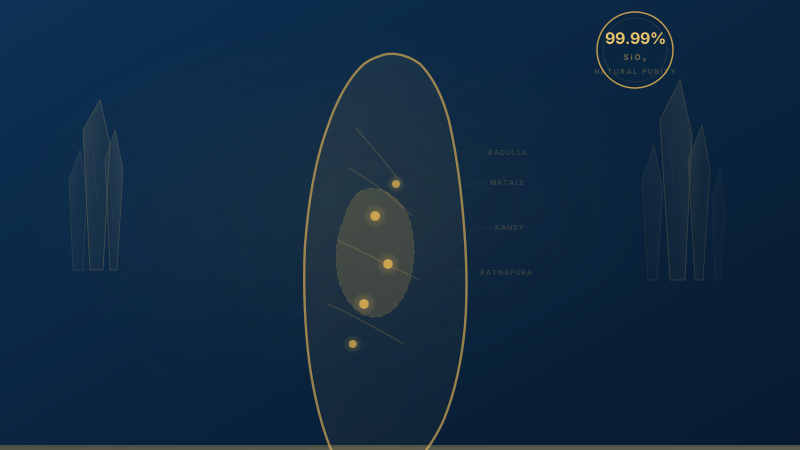
This is exactly where suppliers like Quartz.lk fit in. Our 4N grade HPQ sand, processed from Sri Lanka's naturally high-purity vein quartz, meets the specifications for crucible outer layer material. And the outer layer is the volume play.
Bigger Crucibles, Bigger Demand
The industry trend toward larger crucible sizes is amplifying demand further. Five years ago, 24-inch diameter crucibles were standard in most CZ operations. Today, 28-inch crucibles are the norm at leading manufacturers, and 32-inch crucibles are being adopted for next-generation, high-throughput crystal growth lines.
Larger crucibles mean more quartz per unit. A 32-inch crucible uses roughly 40% more quartz sand than a 24-inch crucible. When you scale that across tens of thousands of annual crucible replacements at a single factory, the tonnage adds up fast. This isn't a subtle shift. It's a structural increase in quartz consumption baked into the industry's own efficiency roadmap.
Who's Consuming All This Quartz?
The five companies that dominate global monocrystalline silicon production are Longi Green Energy, TCL Zhonghuan (formerly Tianjin Zhonghuan Semiconductor), JA Solar, Jinko Solar, and Trina Solar. Together, these firms account for a massive share of the world's solar wafer output. Each operates multiple ingot-pulling facilities across China, and each is a voracious consumer of quartz crucibles.
Longi alone had an ingot capacity exceeding 150 GW per year by late 2024. TCL Zhonghuan wasn't far behind. To put these numbers in context, supplying crucibles for just one of these companies' ingot operations could consume the entire annual output of a mid-sized quartz mine.
And here's the thing that rarely gets mentioned in solar industry coverage: China makes over 80% of the world's solar wafers. That geographic concentration means Chinese crucible manufacturers, and by extension their quartz sand suppliers, are at the epicenter of global HPQ demand.
India's Solar Manufacturing Push Changes the Map
But the map is changing. India's Production-Linked Incentive (PLI) scheme for solar manufacturing, combined with the country's target of reaching 500 GW of non-fossil-fuel energy capacity by 2030, is catalyzing a domestic solar manufacturing ecosystem almost from scratch.
Companies like Adani Solar, Waaree Energies, Tata Power Solar, and Vikram Solar are building integrated manufacturing capacity covering everything from ingots and wafers to cells and modules. India's Bureau of Investment Promotion has been actively courting foreign solar manufacturers to set up shop, particularly in Gujarat, Rajasthan, and Tamil Nadu.
For quartz suppliers, India represents something exciting: a brand-new demand center that's geographically close to Sri Lanka's quartz deposits. Shipping HPQ sand from Colombo to an Indian port takes 3 to 7 days. Compare that with 30-plus days from North American sources. The logistics advantage is significant, and Indian manufacturers know it.
Southeast Asia: The Emerging Third Pole
Beyond China and India, Southeast Asia is quietly building out its own solar manufacturing base. Vietnam, Malaysia, Thailand, and Indonesia are all hosting new cell and module factories, many funded by Chinese manufacturers looking to diversify their production footprint in response to trade tensions and tariff regimes.
Vietnam has become a particularly significant hub, with companies like Jinko Solar, JA Solar, and Canadian Solar operating large-scale module assembly plants there. As some of these operations vertically integrate into wafer and ingot production, they'll need local or regional quartz supply chains. Southeast Asia's proximity to Sri Lanka, again, 5 to 12 days by sea from Colombo, positions it as an accessible market for Sri Lankan HPQ.
Why Solar Is the Volume Play for 4N HPQ
There are several end markets for high purity quartz: semiconductor fabrication, optical fiber production, specialty glass manufacturing, and lighting. All of them are valuable. But none of them come close to solar in terms of sheer tonnage consumed annually.
The semiconductor industry, for all its sophistication, uses relatively small quantities of fused quartz compared to solar. A semiconductor fab might consume a few hundred tonnes of quartz per year. A single solar ingot factory burns through several thousand tonnes.
The math is unambiguous: solar is the market that moves the needle for any quartz supplier operating at industrial scale. If you're producing thousands of tonnes of 4N HPQ per month, your primary addressable market is crucible manufacturing for CZ silicon growth.
This is particularly relevant for outer-layer crucible sand, which doesn't need the ultra-premium 5N purity that commands eye-watering prices. The 4N segment is where volume meets value. It's the workhorse grade that keeps the solar supply chain running.
Supply Concentration Is a Real Risk
One thing that's become abundantly clear over the past few years is that the global HPQ supply chain is dangerously concentrated. The inner-layer crucible market is still heavily dependent on a handful of deposits, primarily in North Carolina. When Hurricane Helene disrupted operations at Spruce Pine in late 2024, the entire solar industry held its breath.
Even the outer-layer supply chain is concentrated, with a relatively small number of qualified sources feeding Chinese crucible manufacturers. This concentration creates vulnerability. Every procurement team at a major crucible maker is actively looking for additional qualified suppliers. Diversification isn't a nice-to-have anymore. It's a strategic imperative.
This is precisely the environment in which new, reliable sources of 4N HPQ can establish themselves. Buyers aren't just looking for the cheapest sand. They want supply security, consistent quality, and geographic diversification.
What Comes Next
The solar industry isn't slowing down. Global installations are on track to exceed 600 GW annually within the next two years. N-type cell technologies like TOPCon and heterojunction (HJT) are gaining market share, and both require monocrystalline silicon grown in quartz crucibles. There's no technology pivot on the horizon that eliminates the need for CZ-grown silicon.
Perovskite tandem cells, often cited as the next big thing, will be layered on top of silicon cells, not replace them. The silicon wafer, and by extension the quartz crucible, remains foundational to solar manufacturing for at least the next decade.
For anyone in the quartz business, the takeaway is straightforward. The solar photovoltaic industry represents the single largest and fastest-growing volume opportunity for 4N high purity quartz. The demand is real, the growth trajectory is structural, and the supply chain needs more qualified players.
The sun isn't just powering the energy transition. It's powering the biggest quartz boom in industrial history.